

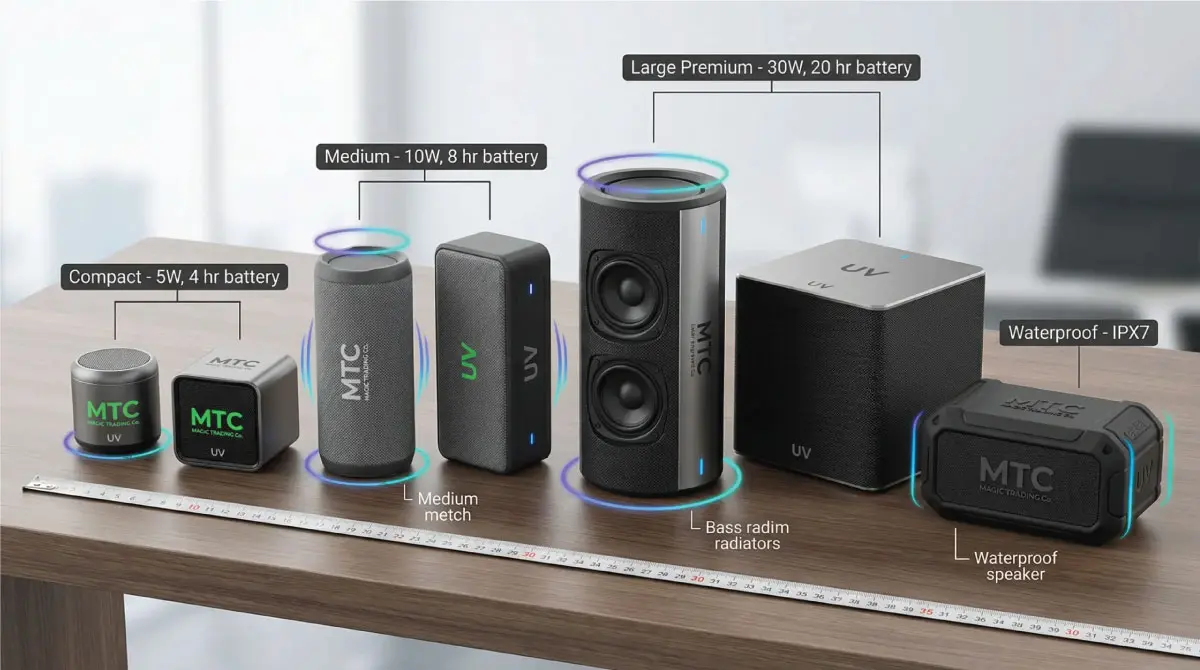
Bluetooth Speaker Promotional Gifts: Size, Sound & Logo Placement Guide
Bluetooth speaker promotional gifts can be incredible for brand recall—when they’re chosen like real products, not like catalogue filler. A speaker lives in personal spaces. It sits on a desk, travels in a car, shows up at picnics, plays music during workouts, and even becomes the background sound at family gatherings. That’s why this category is powerful. Your brand isn’t just “seen.” It’s present in moments people enjoy.
But there’s a hard truth that many companies learn the expensive way: a bad speaker is worse than no speaker. If the sound is thin, the battery is unreliable, the connection drops, or the logo scratches off in a week, the gift stops being a gift. It becomes an annoyance—and annoyances don’t build loyalty.
This guide is built to prevent that outcome. You’ll learn how to choose the right speaker size for the right audience, how to judge sound quality without getting lost in technical jargon, and where to place your logo so it looks premium and stays visible. You’ll also see the common problems companies face when ordering Bluetooth speaker promotional gifts—and the fixes that keep your brand on the right side of the experience.
Why Bluetooth Speaker Promotional Gifts Perform When Other Items Fail
Most promotional products compete for attention. A speaker doesn’t. It competes for use—and that’s a better game. When someone uses a speaker, the brand stays in sight for hours at a time, not seconds.
Bluetooth speaker promotional gifts work especially well because they are:
- Shared: friends, teams, and family members see the speaker, not only the recipient
- Repeatedly used: music, podcasts, calls, background sound, travel, workouts
- High perceived value: even a compact speaker can feel “premium” compared to typical giveaways
- Emotionally linked: sound is tied to mood, memory, and routine
The problem is that a speaker is also a quality-sensitive product. People forgive a cheap pen. They don’t forgive a speaker that annoys them.
The Main Problem with Bluetooth Speaker Promotional Gifts
If you’ve ordered speakers before and were disappointed with the results, it usually comes down to one issue: the purchase was made for the brand, not for the user.
That shows up in predictable ways:
- choosing the cheapest unit that “looks nice”
- picking a design that fits a logo, not a lifestyle
- focusing on loud marketing specs instead of real sound
- selecting a print method that rubs off quickly
- skipping sample testing because timelines are tight
The fix is not complicated, but it does require a change in mindset: choose the speaker like you’re buying it for yourself. Then brand it with restraint.
Start With Size: The Fastest Way to Choose the Right Speaker
Speaker size determines how the product fits into daily life. It impacts portability, battery life, sound fullness, and where the recipient will actually use it.
1) Mini speakers (pocket-sized)
Mini speakers work when your goal is mass distribution and easy gifting. They are light, affordable, and simple to ship.
Best use cases
- events, exhibitions, conferences
- onboarding packs
- wide distribution campaigns
What to expect
- sound is limited and bass is light
- volume is acceptable for small spaces
- perceived value depends heavily on build quality and packaging
Real risk
Many mini speakers sound “thin” and distort quickly. If it feels like a toy, it won’t be used for long.
When mini is a smart choice
When you need thousands of units, and your goal is a light brand touch—not a premium experience.
2) Compact speakers (the best balance for most campaigns)
Compact speakers are usually the best category for Bluetooth speaker promotional gifts. They’re portable, but they can still deliver enjoyable sound.
Best use cases
- client gifting
- staff appreciation
- partner gifting
- mid-range corporate campaigns
Why compact wins
It’s big enough to sound “real” and small enough to be carried. That increases weekly usage—and weekly usage is what creates brand recall.
3) Medium speakers (premium feel, stronger sound)
Medium speakers typically offer fuller sound and better bass. They feel like a real purchase, not a giveaway.
Best use cases
- VIP clients
- premium campaigns
- leadership gifting
- home-office audiences
Why medium can outperform
If the sound is genuinely good, recipients keep it on their desk or in their living space. That’s long-term visibility.
Real risk
If you go medium but cut quality, it’s the worst of both worlds: heavier to distribute and still disappointing.
4) Large / party speakers (high risk for most brands)
Large speakers are rarely the right choice for corporate gifting unless you truly know the recipient lifestyle.
Best use cases
- highly targeted VIP gifting
- entertainment brands
- special campaigns where it fits the audience perfectly
Why it’s risky
Storage, transport, preference mismatch, and “where do I even put this?” are common issues.
Practical rule
For most brands: stay in compact or medium. It’s the sweet spot for use, quality, and distribution.
Sound Quality: What Matters (Without Overthinking Specs)
People don’t judge speakers by technical terms. They judge them by experience. The easiest way to choose a “good sounding” speaker is to focus on three things:
1) Clarity
Voices should sound clean. Podcasts, calls, and speech should be understandable without strain.
Why clarity matters
If voices sound muddy, users stop using the speaker for everyday listening—and that reduces weekly usage.
2) Bass without distortion
Bass should feel full, not rattly. Cheap speakers often push fake bass that breaks down when volume increases.
Simple test
Play a song with steady low-end and turn volume up slowly. If it starts buzzing, that unit will annoy people fast.
3) Volume stability
A speaker should handle normal room volume without harshness. Many budget speakers sound fine at low volume and break apart at medium volume.
Why this matters for gifting
Most people will use the speaker in a room, not at whisper volume. If it can’t handle normal listening, it becomes a drawer item.
Sound direction: desk vs shared spaces
- Forward-facing speakers are excellent for desks, meetings, and office listening.
- 360-degree speakers work well for shared environments like living rooms or outdoor gatherings.
Pick based on where you expect the speaker to live.
The Battery Problem That Kills Usage
Battery life is one of the biggest drivers of long-term usage. A speaker that dies quickly creates friction. Friction makes people stop using it.
Here’s what happens in real life:
- someone uses the speaker twice
- it dies unexpectedly
- they forget where the charging cable is
- they stop reaching for it
- your logo disappears from their routine
What to prioritize
- consistent battery performance over time
- reliable charging behavior
- modern charging (USB-C preferred where possible)
- a battery experience that feels predictable
Important
Ignore unrealistic battery claims. The only way to know is to sample test a unit.
Connectivity: The Fastest Way to Turn a Gift Into a Complaint
A speaker that disconnects creates immediate frustration. That frustration becomes attached to your brand.
For Bluetooth speaker promotional gifts, stable connectivity matters more than fancy features.
What “good connectivity” feels like
- pairs quickly
- reconnects automatically
- stays connected across a normal room distance
- doesn’t stutter when a laptop and phone are nearby
- doesn’t require repeated resets
A practical decision
If you’re gifting corporate audiences, prioritize stable connection over “extra features.” A simple speaker that works every time beats a feature-heavy speaker that frustrates users.
Features That Actually Add Value (and the Ones That Don’t)
You don’t need a speaker with every feature. You need features that match the recipient routine.
Features that increase real usage
- Built-in microphone for calls (useful for office users)
- Water resistance for outdoor lifestyle and UAE use
- Non-slip base for desk stability
- Simple physical controls that are easy to learn
- USB-C charging for modern convenience
Features to be cautious with
- novelty lights (can feel cheap on premium gifting)
- overly complex touch controls (people mis-tap constantly)
- gimmick modes that don’t improve the core experience
A promotional speaker should be easy to use on day one.
Logo Placement Guide: Where Branding Looks Premium and Lasts
This is where many campaigns quietly fail. The wrong logo placement can make the speaker look cheap—or make the branding wear off quickly.
The goal is simple: keep the logo visible, but not intrusive.
Best logo placement areas
1) Front grille corner
This is often the best spot. It’s visible, clean, and doesn’t dominate the design.
Why it works:
- branding feels minimal
- visibility is high
- it looks like a real retail product
2) Side panel
Side placement works well for modern designs and keeps the speaker looking premium.
Why it works:
- logo is seen when the unit is picked up
- design stays clean in personal spaces
3) Back panel
This is a “premium minimal” approach. Visibility is lower, but acceptance is higher—especially for VIP clients.
Why it works:
- doesn’t interfere with the aesthetic
- feels like a brand signature, not an ad
4) Small mark near base
Some designs allow a discreet logo near the base area. It can be subtle and elegant if executed well.
Logo placement areas to avoid
- grip zones where hands constantly rub
- rubberized surfaces that don’t hold print well
- the top surface if it’s frequently touched and scratched
- oversized center logos that dominate the grille
- areas near ports that look messy over time
Simple rule
If the logo makes the speaker look like a giveaway, it will be treated like a giveaway.
Branding Methods: Choose What Lasts, Not What’s Cheapest
Your print method can upgrade the entire gift—or ruin it.
1) Laser engraving
Best for metal plates or certain casing designs.
Why it’s strong:
- looks executive
- doesn’t fade
- feels premium without being loud
2) UV printing
Great for sharper detail and full-color logos.
What to watch:
- durability depends on surface coating
- always test for scratch resistance
3) Pad printing
Common for large-volume campaigns.
Pros:
- cost-effective
- clean for simple logos
Cons:
- may wear over time with daily handling
- quality varies by supplier
4) Metal badge plate
Can look premium if minimal.
What to watch:
- bulky plates can feel cheap
- avoid crowded designs
Practical advice
If your brand is premium, use premium branding techniques. A speaker can’t feel high-end with low-end print.
Matching Bluetooth Speaker Promotional Gifts to Recipient Tiers
A tier strategy keeps gifting consistent and prevents mismatched experiences.
Tier A: VIP clients and executives
Goal: premium experience, minimal branding, strong sound.
Best approach:
- compact premium or medium speaker
- strong clarity and stable connection
- subtle branding (engrave or minimal UV)
- rigid box + greeting card
Tier B: clients, partners, vendors
Goal: reliable, professional, widely usable.
Best approach:
- compact speaker with stable performance
- good battery experience
- clean logo placement
- neat packaging
Tier C: events and mass gifting
Goal: simple, portable, decent quality, low friction.
Best approach:
- mini or compact speaker
- prioritize stability over features
- simple branding
- cost-efficient packaging
Tiering is how you avoid giving a “cheap-feeling” product to someone you want to impress.
Packaging: The Upgrade Most Brands Forget
A speaker already has higher perceived value than many promotional items. Packaging can multiply that value.
A strong presentation includes:
- a firm box or premium sleeve
- an insert that prevents movement
- a quick-start card (pairing + charging steps)
- cable neatly arranged
- optional greeting card for seasonal gifting
Why a quick-start card matters
Many users blame the speaker when they don’t understand pairing or controls. A short card reduces confusion and improves first impressions.
First impressions decide whether the gift becomes routine.
The “Sample Test” That Saves You from Bad Bulk Orders
Never order speakers in bulk without testing a sample. Even a quick test prevents expensive disappointment.
What to test in 10–15 minutes
- play audio at low and medium volume
- raise volume gradually and listen for distortion
- test a podcast or voice clip for clarity
- walk around a room to check connection stability
- test pairing with both phone and laptop if possible
- check buttons and controls: are they simple and responsive?
- check build: does it feel solid or hollow?
What to test over 2–3 days
- battery consistency
- charging reliability
- logo durability (light rub test)
- whether you naturally reach for it again
A speaker that passes these tests becomes a safe promotional gift.
How to Make Bluetooth Speaker Promotional Gifts Feel “Real” and Not Promotional
If you want this gift to feel like a genuine product, focus on these three choices:
- Choose neutral colors and finishes
Matte black, dark grey, clean white, brushed metal accents. These look like retail tech. - Brand subtly
One logo placement is enough. Don’t plaster branding everywhere. - Package like a gift
A clean box, a simple card, and a quick-start guide make it feel intentional.
When a speaker feels like a retail product, people use it proudly.
Bluetooth Speaker Promotional Gifts That Work Best Inside Gift Sets
Speakers become even stronger when combined with items that support the same routine.
High-performing pairings:
- tech organizer pouch
- charging cable kit
- power bank (for travel kits)
- premium notebook and pen
- insulated tumbler (for lifestyle and desk kits)
Bundling increases perceived value and makes the campaign feel planned rather than random.
If you’re building corporate gift kits and need consistency across categories, magic trading can help source reliable tech gift items and keep branding and packaging clean. For broader item pairing and campaign variety, exploring promotional gifts helps you build sets that don’t feel repetitive across seasons.
Final Checklist for Ordering Bluetooth Speaker Promotional Gifts
Before you approve a bulk order, confirm:
- speaker size matches the audience (mini, compact, medium)
- sound remains clear at normal room volume
- no distortion at higher volume
- stable connection and quick pairing
- battery feels predictable and reliable
- charging is modern and convenient (USB-C preferred where possible)
- branding method is durable (engrave/UV/pad tested)
- logo placement won’t rub off quickly
- packaging supports premium perception
- sample tested before bulk order
If you can tick these off, your Bluetooth speaker promotional gifts won’t just be distributed. They’ll be used—and your brand will stay present in the moments people enjoy.
Frequently Asked Questions
What size is best for Bluetooth speaker promotional gifts?
For most campaigns, compact speakers deliver the best balance of portability and enjoyable sound. Mini speakers work for large events, while medium speakers are better for VIP gifting where premium sound matters.
How do I choose a speaker that sounds good without being an audio expert?
Focus on clarity for voices, bass without distortion, and stable sound at normal room volume. Sample test a unit before bulk ordering and listen at medium volume, not just low volume.
Where should a logo be placed on a promotional Bluetooth speaker?
A small logo on the front grille corner or a clean side panel typically looks premium and stays visible. Avoid oversized center logos and areas where hands constantly rub.
Which branding method lasts the longest on speakers?
Laser engraving lasts the longest when supported by the casing design. UV printing works well for detailed logos on quality surfaces. Pad printing is cost-effective for large volumes but should be tested for wear.
Can Bluetooth speaker promotional gifts be included in corporate gift sets?
Yes. Speakers pair well with tech organizers, cable kits, notebooks, drinkware, and power banks—especially when you build tiered gift kits for different recipient groups.