
Hot Foil Stamping Equipment for Enterprises in the UAE
Hot foil stamping is no longer a niche finishing technique used only by luxury brands. In 2026, it has become a practical competitive tool for UAE businesses that want packaging, labels, printed cards, certificates, invitations, and promotional materials to look more premium without completely changing their production model.
That shift matters in the UAE. Businesses are operating in a market that rewards presentation, brand differentiation, and faster turnaround. At the same time, the UAE continues to push industrial growth, digital transformation, and smarter manufacturing through initiatives such as Operation 300bn and UAE Industry 4.0, while circular packaging and waste-management policies keep sustainability in focus. That makes finishing equipment decisions more strategic than they were a few years ago.
For a UAE business owner, the key question is not simply, “What is the best hot foil stamping machine?” The real question is, “Which machine fits my products, order volume, margin, staffing, and growth plan?”
This guide explains the answer in clear terms. Whether you run a print shop, packaging company, promotional products business, publishing house, or brand that wants more control over finishing, this article will help you make a smarter decision.
What hot foil stamping is and why it matters
Hot foil stamping is a printing and finishing process that uses heat, pressure, and a metal die to transfer foil onto a surface. The foil can be metallic, matte, pigmented, holographic, or textured depending on the visual effect you want. Official manufacturer documentation shows the process is widely used on paper, carton board, laminated board, plastics, and other substrates, and it can also be combined with embossing and holographic effects.
In simple terms, a hot foil stamping machine lets you add shine, texture, and a premium finish to printed materials.
That is valuable in the UAE because many industries depend on strong first impressions. Think about luxury packaging, cosmetics, confectionery, hospitality collaterals, real estate brochures, branded stationery, premium invitations, retail gift boxes, government-style certificates, and corporate promotional products. In these categories, appearance influences perceived quality.
Foil stamping is especially useful when you want to:
- make a brand look more premium
- create shelf impact in a competitive retail environment
- add tactile or metallic details without redesigning the entire product
- offer higher-margin finishing services to clients
How hot foil stamping machines work
The core process is straightforward.
First, artwork is converted into a die. This die is usually metal and shaped to match the logo, text, border, or pattern you want to stamp.
Second, the machine heats the die to the required temperature.
Third, foil is fed between the heated die and the substrate.
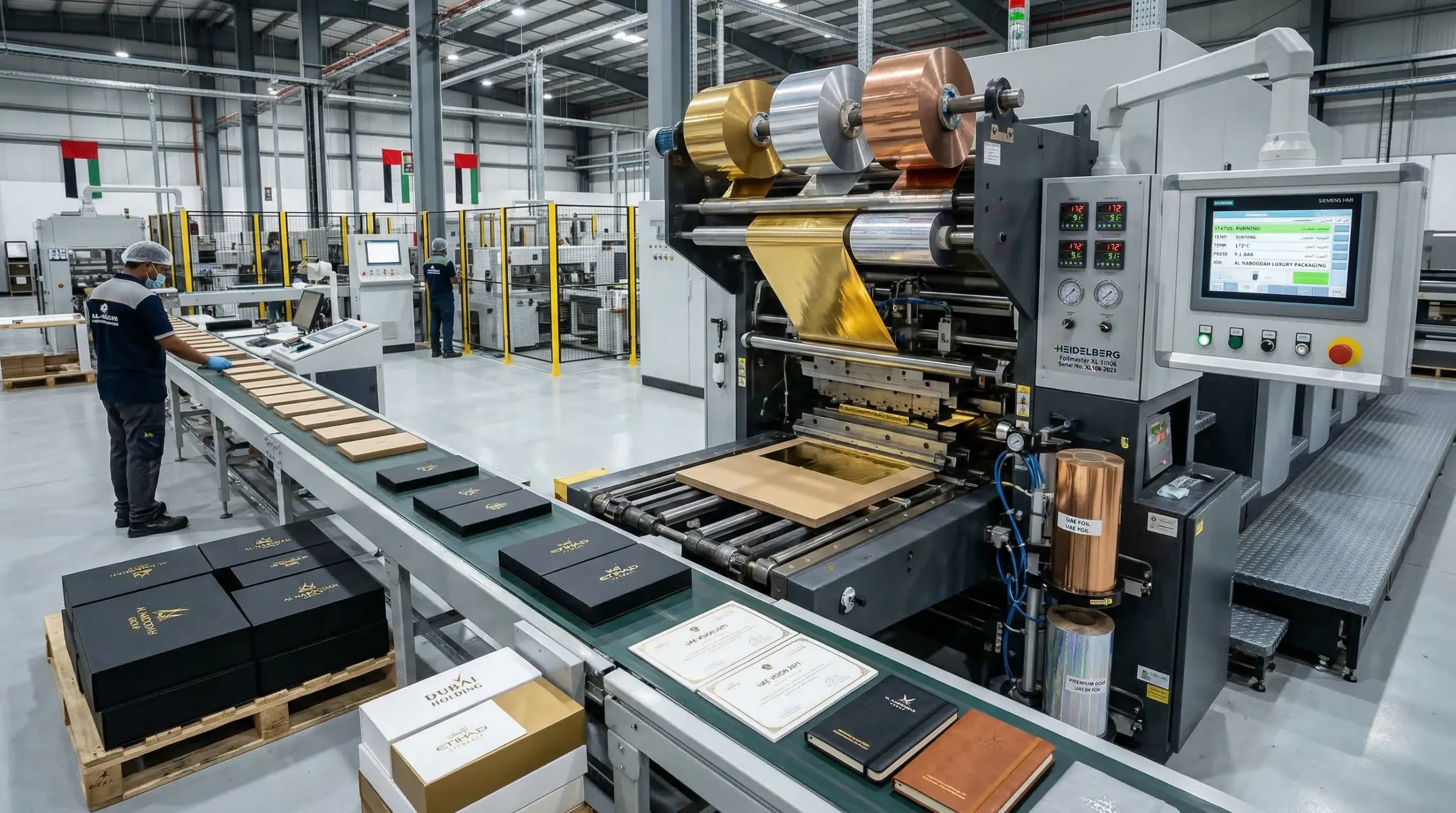
Fourth, pressure is applied for a controlled dwell time so the decorative layer transfers cleanly onto the material.
Fifth, the sheet or roll moves forward and the finished piece exits with the foil effect in place.
What separates a good machine from an average one is not the basic concept. It is the consistency of heat, pressure, registration, foil feeding, waste control, speed, and ease of setup.
Modern systems now go much further than basic stamping. Some automatic presses combine hot foil stamping with die-cutting, stripping, and blanking in a single workflow, while newer digital embellishment systems can produce flat or raised metallization with less setup for short runs and customized jobs.
Main types of hot foil stamping machines
Manual and entry-level platen machines
These are best for small workshops, craft businesses, prototype production, and low daily volume.
They are usually cheaper to buy and simpler to understand, but they are slower, more labor-dependent, and less suitable for scale. They can still make sense for UAE startups offering boutique packaging, wedding invitations, or short-run branded stationery.
Semi-automatic flatbed machines
These are a step up for businesses that need better consistency and more output without jumping straight to a high-capital investment.
They reduce operator fatigue, improve repeatability, and often support a wider range of jobs. For many small and mid-sized UAE print businesses, this is the practical middle ground.
Automatic sheet-fed hot foil stamping machines
These are the serious production machines.
They are built for higher volumes, tighter registration, better uptime, and faster makeready in demanding commercial environments. Official machine specifications from major manufacturers show that this class often includes advanced heating zones, foil-saving controls, quick tool changes, and in some cases integrated die-cutting functions.
If your business handles packaging for cosmetics, confectionery, tobacco alternatives, gift boxes, premium cartons, or brand-heavy retail products, this category is often the right long-term investment.
Roll-to-roll or web-fed systems
These are better suited for continuous production formats such as labels, sleeves, and flexible packaging applications.
They are ideal when your business depends on narrow-web or web-fed converting rather than sheet-fed commercial print.
Digital foil and digital embellishment systems
These are not always direct replacements for traditional hot foil machines, but they are increasingly relevant in 2026.
Industry showcases and manufacturer platforms highlight growing interest in digital metallization, variable embellishment, shorter setup times, and premium effects for smaller runs. This is especially important for UAE businesses serving luxury launches, event-specific jobs, seasonal campaigns, mockups, and premium short-run packaging.
Key features to evaluate before buying
Not every machine that looks impressive on paper is right for your operation. Focus on the features that affect profitability.
1. Substrate compatibility
Check what materials you actually run today and what you may run next year. Paperboard, rigid cartons, laminated stock, synthetic material, labels, and plastic-based substrates behave differently under heat and pressure.
2. Format size
Do not buy for your smallest job. Buy for your most profitable realistic job. The maximum sheet or web width will determine what clients you can serve.
3. Heating control
Consistent temperature matters. Uneven heating leads to weak transfer, patchiness, or foil waste.
4. Pressure stability
A machine that cannot deliver controlled pressure will struggle with fine details, solid areas, and textured surfaces.
5. Registration accuracy
This matters even more if the foil needs to sit perfectly over printed graphics or if you plan to combine foil with embossing.
6. Foil feed and waste reduction
Foil is a recurring cost. Better foil management can improve margins over time, especially on larger runs.
7. Makeready time
Slow setup destroys profitability in short and medium runs. Fast changeovers are a real business advantage.
8. Service and spare parts
In the UAE, this point is critical. A cheaper machine with weak regional support can become more expensive than a premium machine with reliable service availability.
Why hot foil stamping makes business sense in the UAE
The UAE market rewards premium presentation. That is true in retail, gifting, hospitality, events, real estate, luxury goods, and branded corporate materials.
Hot foil stamping can help UAE businesses in several ways.
First, it raises perceived value. A simple box, invitation, or brochure can look significantly more premium with clean metallic or textured finishing.
Second, it creates a differentiator. When many products are competing on the same shelf or in the same sales environment, finishing can influence attention before the customer reads the copy.
Third, it supports higher-margin services. If you are a printer or packaging supplier, foil stamping is not just a production feature. It can become a premium upsell.
Fourth, it can align with smarter production goals. Official UAE policy direction continues to encourage industrial modernization, digital transformation, and more sustainable production thinking, which supports investment in equipment that improves efficiency and value-added output.
UAE market trends and opportunities in 2026
Several trends make 2026 a strong time to evaluate hot foil stamping equipment.
The first is industrial expansion. The UAE’s industrial strategy aims to grow manufacturing contribution and support SMEs, and the government continues to position advanced production as a national priority.
The second is Industry 4.0 adoption. UAE programs now emphasize digital maturity, productivity, and factory transformation. That favors machines with better control systems, data visibility, lower waste, and easier integration into modern workflows.
The third is demand for embellishment and finishing. Regional print events continue to highlight finishing, embellishment, labels, and packaging technologies, while global print exhibitions have put digital foiling and high-value finishing at the center of innovation conversations.
The fourth is sustainability pressure. UAE circular economy and waste-management efforts mean buyers are paying closer attention to material efficiency, energy use, and responsible production choices.
The result is a clear opportunity: UAE businesses that offer premium finishing with good operational discipline can position themselves in a stronger part of the market.
How to choose the right machine step by step
Step 1: Define your core application
Start with the real work you want the machine to do.
Are you finishing luxury boxes? Business cards? Certificates? Labels? Cosmetics packaging? Gift items? Wedding stationery? Promotional products?
A machine that is perfect for rigid cartons may be wrong for labels. A machine that is ideal for short-run premium cards may be inefficient for high-volume carton work.
Step 2: Estimate your run lengths honestly
Do not buy a large automatic press if your real production is mostly small custom runs.
Likewise, do not stay with a manual unit if demand is already causing delays, inconsistent quality, or lost sales.
Step 3: Match the machine to your substrate mix
Different substrates need different temperature, pressure, dwell time, and feeding stability. Test with real materials, not just vendor samples.
Step 4: Decide whether you need traditional, digital, or hybrid capability
Traditional hot foil stamping is usually stronger for long runs, deep premium finishing, and certain packaging applications.
Digital embellishment may be better for prototypes, personalization, shorter runs, and faster changeovers.
Many UAE businesses may benefit from a hybrid mindset rather than an either-or mindset.
Step 5: Calculate total cost of ownership
Do not focus only on the machine price.
Your real cost includes:
- dies
- foil consumption
- electricity
- compressed air if needed
- operator training
- maintenance
- service visits
- spare parts
- setup waste
- downtime risk
Step 6: Check local support before you sign
Ask direct questions:
How fast are spare parts available?
Who handles installation in the UAE?
Is operator training included?
What is the preventive maintenance schedule?
Can the supplier provide local references?
Step 7: Run a live sample test
This step should never be skipped.
Send your actual artwork and substrate. Check registration, coverage, sharpness, speed, waste, and consistency. A machine should prove itself on your job, not only in a brochure.
Maintenance, operating best practices, and cost control
A hot foil stamping machine becomes profitable when it stays consistent.
Keep dies clean. Monitor heat zones carefully. Use the correct foil for the substrate. Store foil properly in stable environmental conditions. Train operators to recognize early signs of misregistration, weak transfer, wrinkling, and overheating.
Preventive maintenance matters more than reactive maintenance. Build a routine for:
- cleaning feeding and delivery areas
- checking pressure settings
- inspecting heating elements
- verifying foil path alignment
- monitoring wear parts
- calibrating registration systems
Operational discipline also reduces cost.
Many businesses lose money not because the machine is poor, but because setup waste is high, foil selection is wrong, or operators keep chasing quality problems during production.
If you are operating in one of the emirates covered by recent reduced industrial energy tariff programs, that may also affect long-term cost planning for production equipment.
Common challenges and practical solutions
One common issue is poor foil adhesion. This usually points to the wrong temperature, insufficient pressure, unsuitable foil, or substrate coating problems.
Another problem is patchy coverage. In many cases, the cause is uneven pressure, inconsistent heat, or a die issue.
Wrinkling and misalignment often come from weak foil tension control or unstable feeding.
Slow profitability is another common challenge. Businesses sometimes buy too much machine for too little work, or they underestimate training and setup time.
The solution is simple in principle: buy for the business you can realistically build in the next two to three years, not for a fantasy scenario and not only for today’s smallest jobs.
FAQ: Hot foil stamping machines for UAE businesses
Is a hot foil stamping machine worth it for a small UAE business?
Yes, if premium finishing is directly linked to your sales or margins. For short-run boutique work, an entry-level or semi-automatic machine may be enough. For growing commercial demand, automatic equipment usually makes more sense.
What industries in the UAE benefit most from foil stamping?
Packaging, cosmetics, luxury retail, promotional products, hospitality printing, publishing, events, invitations, labels, confectionery, and premium corporate stationery.
What is the difference between hot foil stamping and digital foil embellishment?
Hot foil stamping uses heat, pressure, foil, and a die. Digital embellishment reduces or changes some of that setup and is often more flexible for short runs, prototypes, and personalization.
How much should I budget besides the machine itself?
Budget for dies, foil, operator training, service, spare parts, maintenance, setup waste, and utilities. Total ownership cost matters more than sticker price.
Can foil stamping work on all materials?
No. Many materials work well, but results depend on substrate type, coating, surface texture, and the machine’s operating range. Always test before buying.
Is local technical support in the UAE important?
Absolutely. Service response, spare parts access, and operator training can directly affect your uptime and profitability.
Should I choose manual, semi-automatic, or automatic?
Choose based on daily output, consistency needs, staffing, and growth plan. Most businesses outgrow manual systems quickly once demand becomes stable.
Final thoughts
For UAE businesses in 2026, hot foil stamping is not just about decoration. It is about product positioning, margin improvement, and building a stronger visual identity in a competitive market.
The best investment is not necessarily the biggest machine or the newest technology label. It is the machine that fits your substrates, order profile, service support needs, and commercial goals.
If you choose carefully, test properly, and operate with discipline, a hot foil stamping machine can become one of the most profitable finishing investments in your production line.